Automated quantity takeoff.
Quantity takeoff is 60–70% of the time in a bid and almost all of it is repetitive. Automating it is the single biggest lever in estimating. Here's how it works.
What it means
Automated quantity takeoff is the use of AI to extract the counts, lengths and areas from a plan set automatically — devices, fixtures, equipment, conduit and pipe runs, wall and floor areas — instead of an estimator tracing each one by hand. The AI detects and classifies elements, measures and counts them, reconciles against schedules, and returns structured quantities for review. Because counting and measuring is the repetitive 60–70% of takeoff time, automating it is what frees estimators to bid more and review more carefully.
How Pilars does it
Pilars extracts quantities with trade-specific models across 48 CSI divisions, attaches a confidence score and sheet reference to every line, reconciles cross-sheet schedules, and flags code issues — so the output is not just fast but reviewable and defensible.
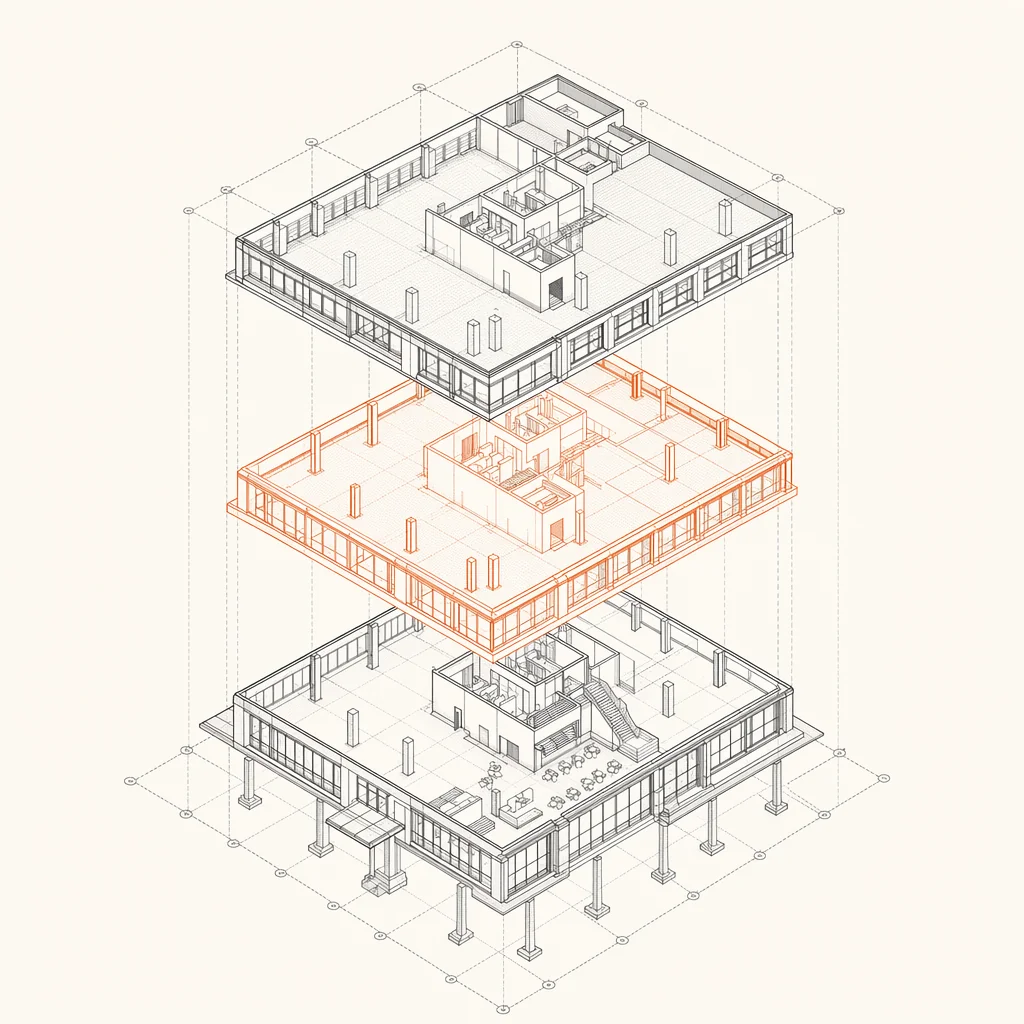
Everything Pilars does
Reads the whole set + spec book
Pilars reads every sheet and the specification book together, resolving references across sheets and schedules — not just one floor plan in isolation.
Trade-specific models
Counts devices, fixtures and equipment and traces runs across 48 CSI divisions — real trade takeoff, not generic area measurement.
Code-compliance flagging
Every takeoff is checked against IBC, NEC, IPC, IMC, ADA and NFPA, so compliance risk surfaces before the bid goes out.
Confidence score on every line
Each quantity carries a confidence score sourced to the exact sheet, so review is fast, targeted and defensible to the GC.
Cross-sheet reasoning
Resolves door, window and fixture schedules and one-line references the way a senior estimator would — catching scope the plan alone hides.
Cloud, with clean exports
Nothing to install. Export bid-ready quantities to Excel, Sage, WinEst and your estimating tool of choice.
Why estimating teams choose Pilars
- 8x faster bidding — a multi-hour takeoff becomes a short review of confidence-scored quantities.
- 94% takeoff coverage on the first pass, so estimators refine rather than rebuild.
- Bid 2–3x more jobs without hiring — and for subs, win rate rises with bid volume.
- $100 per trade, per plan — no per-seat licenses, unlimited projects.
- Quantities sourced to the sheet with a confidence score — defensible to owners and GCs.
Frequently asked questions
What quantities can AI extract automatically?
Symbol counts (devices, fixtures, equipment), linear runs (conduit, pipe, duct), areas and volumes (walls, floors, concrete), and assembly-based quantities — varying by trade and drawing quality.
How accurate is automated quantity extraction?
Within a few percent of manual on standard elements; lower on complex MEP, custom work and poor scans. Confidence scoring flags where to look.
Does automated takeoff handle revisions?
Pilars supports revision-aware re-takeoff, so a drawing update produces an updated quantity set rather than a full manual re-count.
Can it tell where a quantity came from?
Yes — each Pilars quantity is sourced to the exact sheet, so you can verify any line against the drawing.
Which trades benefit most from automated takeoff?
High-count trades — electrical and plumbing especially — see the biggest time savings, but every trade benefits from removing manual counting.
How much does Pilars cost?
Pilars is $100 per trade, per plan, with no per-seat licenses and unlimited projects — so a shared estimating team scales without seat creep.
Which trades does Pilars support?
Electrical, plumbing, HVAC, concrete and rebar, drywall, doors and windows, finishes, flooring, structural steel, roofing and millwork — trade-specific models across 48 CSI divisions.
Does Pilars replace estimators?
No. Pilars automates the extraction and validation — the counting, measuring, reconciliation and code checks — while the estimator owns pricing, scope judgment and risk. It removes the bottleneck, it doesn't remove the expert.
Does Pilars read specifications, not just drawings?
Yes. Pilars reads the spec book alongside the drawings and resolves references across sheets and schedules, so scope that lives in the specs is captured in the takeoff.