Concrete takeoff calculator.
Type in your slabs, footings and walls. Get the whole material list — ready-mix yardage and trucks, gravel base, vapor barrier, mesh, form lumber, stakes, cure & seal and joints — and download it as a proper Excel takeoff template with live formulas.
| Element | Type | Length (ft) | Width / Wall ht (ft) | Thickness (in) | Volume CY |
|---|
| Material | Qty | Unit | How it’s figured |
|---|
How the math works
Every factor in this calculator is a standard estimating rule of thumb, and every one of them is visible in the Excel download so you can audit or adjust it:
- Cubic yards — length × width × (thickness ÷ 12), divided by 27. A foundation wall uses length × wall height × (thickness ÷ 12) ÷ 27. The total gets your waste % and is rounded up to the nearest 0.25 CY, the way the plant takes the order.
- Trucks — total CY (with waste) ÷ 10 per full mixer, rounded up. Under ≈2 CY, bagged is usually cheaper — roughly 45 of the 80-lb bags per cubic yard.
- Gravel base — slab + flatwork footprint × (base depth ÷ 12) ÷ 27, times a 1.15 compaction allowance.
- Vapor barrier — slab area × 1.1 for laps, then ÷ 2,000 SF per 20′ × 100′ roll of 10-mil sheeting.
- Wire mesh — slab area ÷ 42 for 5′ × 10′ sheets with 6″ laps.
- Edge form lumber — total edge-form LF × 1.1, sized to thickness: 2×4 for ≤4″, 2×6 for ≤6″, 2×12 for footings.
- Wall forming — both faces of every wall = 2 × length × height in SF; ÷ 32 gives 3/4″ plyform sheets.
- Form stakes & oil — one stake per 3 LF of edge form; one gallon of form-release oil per 400 SF of form contact area.
- Cure & seal — one gallon per 250 SF of finished flatwork.
- Joints — expansion/isolation joint runs the perimeter of slabs and flatwork.
- Anchor bolts — walls only: one per 6 LF of wall, plus two per wall.
- Rebar — figured separately, on the rebar takeoff calculator.
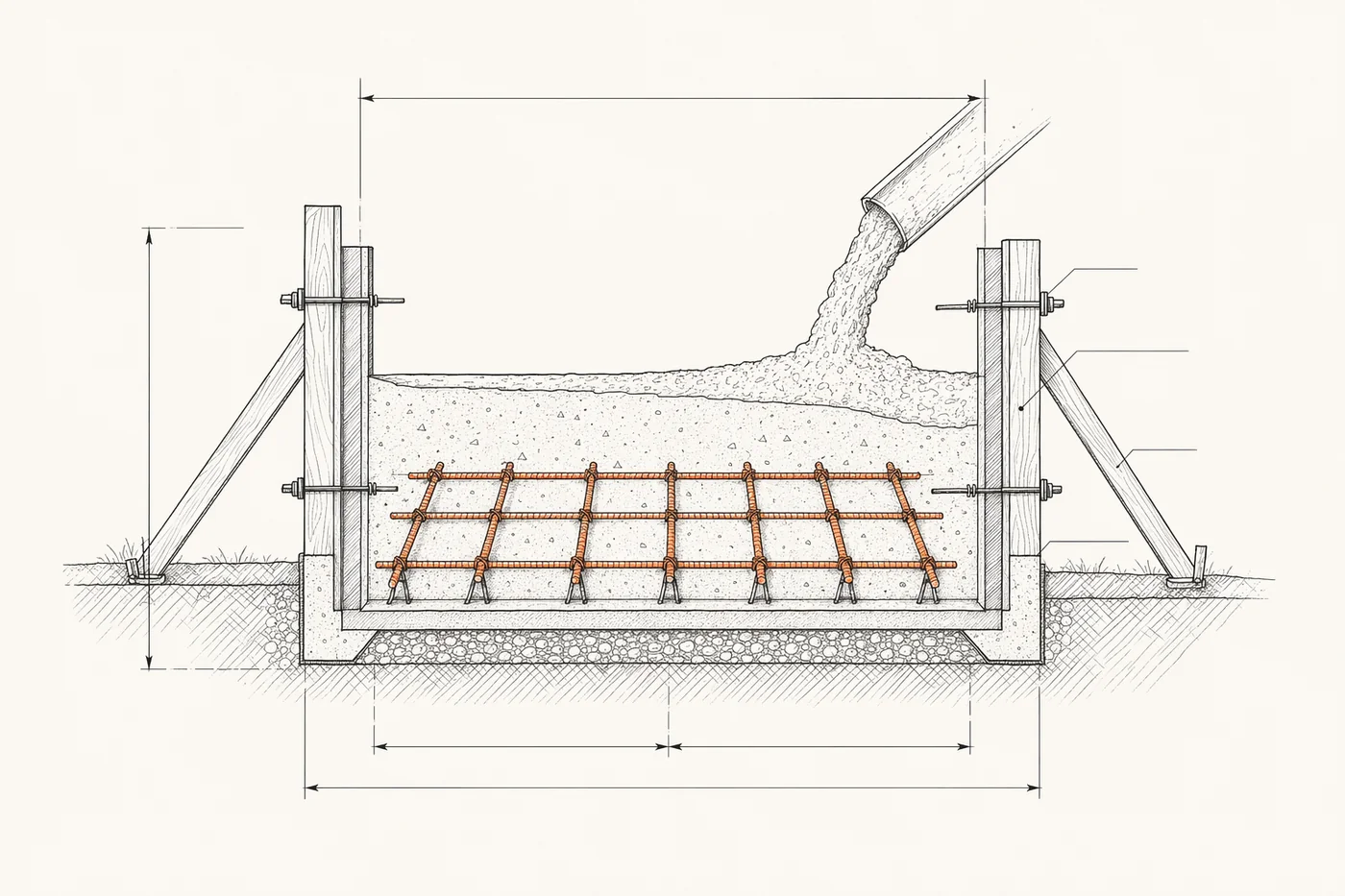
The dimensions you type are dimensions you already found.
A calculator prices the pours once you’ve read every footing schedule, scaled every slab and pulled every wall section by hand — that’s the slow part. What it can’t do is read a structural set: the stepped footings, the thickened slab edges, the different mix on the deck versus the grade beams, the keyway and waterstop notes. That’s the part of a concrete bid that takes the day — and it’s exactly what Pilars AI takeoff does from your actual plans: it reads the footing schedule, picks up slab edges and wall sections, and returns yardage, forms, base and finishing by element. $100 per trade, per plan.
Questions estimators actually ask
How does the calculator figure cubic yards?
For each element: length × width × thickness, with thickness converted from inches to feet, divided by 27. A foundation wall uses wall height as the second dimension. The total gets your waste factor and is rounded up to the nearest 0.25 CY, the way a ready-mix plant takes the order.
How many concrete trucks will I need?
Total cubic yards (including waste) ÷ 10 — a standard full mixer load — rounded up. For pours under about 2 CY, bagged concrete is usually cheaper: roughly 45 of the 80-lb bags make one cubic yard.
Does it calculate gravel base, vapor barrier and wire mesh?
Yes — gravel base from slab and flatwork footprint at the depth you set, with a compaction allowance; vapor barrier with a lap allowance converted to 20×100 rolls; and wire mesh converting slab area into 5×10 sheets allowing for 6″ laps. Each toggles on or off.
Can I download the takeoff as an Excel file?
Yes — one click exports a real .xlsx workbook with an Elements sheet and a Materials sheet. The cells carry live Excel formulas, so you can change dimensions, mix, waste or base depth inside Excel and everything recalculates. There’s a blank reusable template too.
Is this as accurate as a real plan takeoff?
It’s a fast estimating tool built on standard industry factors. It doesn’t read your footing schedule, slab edge details or wall sections — that’s what Pilars does from your actual structural drawings for $100 per trade.
Let Pilars take off your whole set.
Upload your plans. Pilars reads the footing schedule, picks up slab edges and thickened sections, separates mixes by element, and returns the full concrete takeoff. $100 per trade.