HVAC takeoff calculator.
Type in your room areas. Get cooling tonnage, airflow, the whole material list — supply diffusers, return grilles, flex and trunk duct, dampers, sealant, thermostats — and download it as a proper Excel takeoff template with live formulas.
| Zone / room | Floor area (SF) | Ceiling ht (ft) | CFM | Diffusers | Returns |
|---|
| Material | Qty | Unit | How it’s figured |
|---|
How the math works
Every factor in this calculator is a standard estimating rule of thumb, and every one of them is visible in the Excel download so you can audit or adjust it:
- Airflow (CFM) per zone — floor area × your CFM-per-SF setting (default 1.0).
- Supply diffusers per zone — floor area ÷ SF per diffuser (default 125), rounded up.
- Return / filter grilles per zone — floor area ÷ SF per return (default 400), rounded up.
- Cooling capacity (tonnage) — total floor area ÷ SF per ton (default 500), rounded up to the nearest ½ ton. Verify against a Manual J load calc.
- Register boots — one per supply diffuser.
- Flex duct — diffuser count × average branch run (default 12 LF) × (1 + waste); ordered in 25′ boxes (LF ÷ 25, rounded up).
- Trunk / sheet-metal duct — total SF ÷ 100 × trunk factor (default 4 LF per 100 SF) × (1 + waste).
- Volume dampers — one per supply diffuser.
- Duct hangers / straps — trunk LF ÷ 8 + flex LF ÷ 4, rounded up.
- Duct sealant (mastic) — (trunk LF + flex LF) ÷ 100, rounded up, in gallons.
- Foil tape — (trunk LF + flex LF) ÷ 150, rounded up, in rolls.
- Thermostats — one per zone with floor area greater than zero.
- Condensate drain PVC ¾″ — 20 LF per system (one system assumed).
- Refrigerant lineset — 25 LF, a typical run — adjust for your equipment locations.
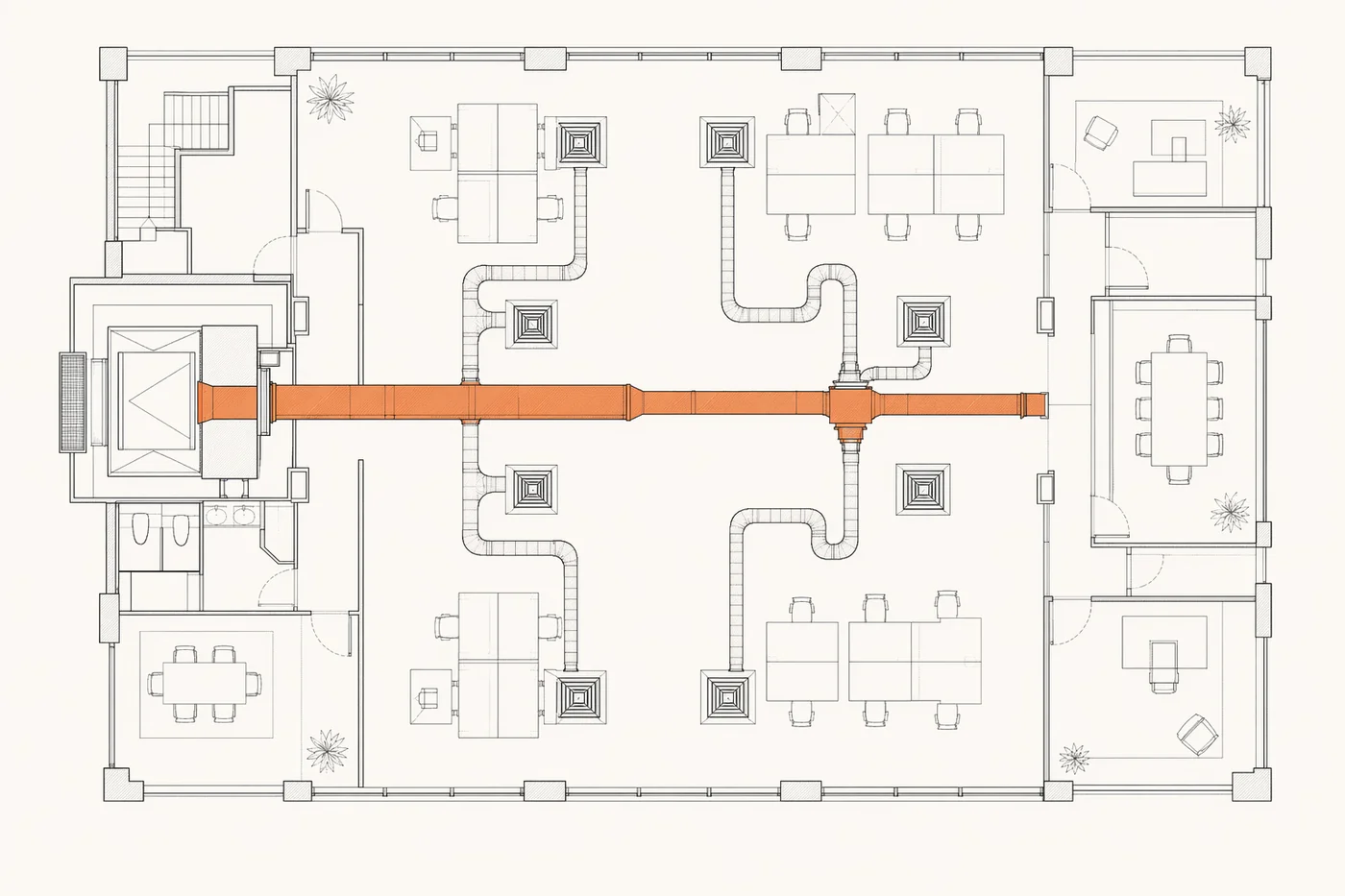
A SF-based calculator can’t read your mechanical schedule.
A per-square-foot calculator gives you a budget number for the spaces you already understand. What it can’t do is read a mechanical set: the equipment schedule with each RTU and split system, the duct sizing on the airflow diagrams, the diffuser and grille schedule with real neck sizes and CFM callouts, the zoning, the VAV boxes, the exhaust and makeup-air. That’s the part of an HVAC bid where the money is — and it’s exactly what Pilars AI takeoff does from your actual plans: it reads the mechanical schedule, counts every diffuser, grille and piece of equipment by tag, follows the ductwork, and returns the full HVAC takeoff. $100 per trade, per plan.
Questions estimators actually ask
How does the calculator figure tonnage?
It adds up the floor area of every zone you enter and divides by your SF-per-ton rule of thumb (default 500 SF/ton), then rounds up to the nearest half-ton. It’s a quick sizing estimate — a real install should be sized from a Manual J load calculation, not a per-SF factor.
How is CFM and the number of diffusers calculated?
Airflow per zone is floor area × your CFM-per-SF setting (default 1.0). Supply diffusers are the zone area ÷ SF per diffuser (default 125 SF each), rounded up; return/filter grilles are zone area ÷ SF per return (default 400 SF each), rounded up.
What ductwork and materials does it calculate?
Flex duct (diffuser count × average branch run × waste, in LF and 25′ boxes), trunk/sheet-metal duct (total SF ÷ 100 × trunk factor × waste), register boots, volume dampers, duct hangers and straps, duct mastic in gallons, foil tape in rolls, thermostats per zone, condensate drain PVC and a typical refrigerant lineset.
Can I download the takeoff as an Excel file?
Yes — one click exports a real .xlsx workbook with a Zones sheet and a Materials sheet. The cells carry live Excel formulas, so you can change room areas, CFM per SF, SF per ton or waste inside Excel and everything recalculates. There’s a blank reusable template too.
Is this as accurate as a Manual J / Manual D design?
No — it’s a fast estimating tool built on standard per-SF factors, useful for budgeting and rough material counts. It doesn’t read your mechanical schedule, equipment selections, duct sizing or zoning — that’s what Pilars does from your actual drawings for $100 per trade.
Let Pilars take off your whole set.
Upload your plans. Pilars reads the mechanical schedule, counts every diffuser, grille and unit by tag, follows the ductwork, and returns the full HVAC takeoff. $100 per trade.