Plumbing takeoff calculator.
Count your fixtures. Get the whole rough-in material list — supply pipe by size, drain, vent, fittings, angle stops, supply lines, P-traps, valves and your WSFU/DFU loads — and download it as a proper Excel takeoff template with live formulas.
| Fixture type | Qty | WSFU | DFU |
|---|
| Material | Qty | Unit | How it’s figured |
|---|
How the math works
Every fixture carries a set of standard rough-in factors. The calculator multiplies each factor by your quantity, groups by pipe size, then applies your trunk/main adder on the supply and a waste percentage on everything. Here is the full factor table — it is also embedded in the Excel download as a visible reference block you can audit or adjust:
| Fixture | Hot LF | Cold LF | Supply size | Drain LF | Drain size | Vent LF | Stops | Supply lines | Trap | WSFU | DFU | Extras (per fixture) |
|---|---|---|---|---|---|---|---|---|---|---|---|---|
| Water closet | 0 | 10 | 1/2″ | 8 | 3″ | 6 | 1 | 1 | – | 2.2 | 3 | wax ring 1, closet flange 1 |
| Lavatory | 10 | 10 | 1/2″ | 6 | 1-1/2″ | 6 | 2 | 2 | 1-1/4″ | 1.0 | 1 | – |
| Kitchen sink | 12 | 12 | 1/2″ | 8 | 1-1/2″ | 6 | 2 | 2 | 1-1/2″ | 1.5 | 2 | basket strainer 1 |
| Shower | 12 | 12 | 1/2″ | 8 | 2″ | 6 | 0 | 0 | 2″ | 2.0 | 2 | shower valve 1, drain assy 1 |
| Bathtub | 12 | 12 | 1/2″ | 8 | 1-1/2″ | 6 | 0 | 0 | – | 2.0 | 2 | tub valve 1, waste & overflow 1 |
| Urinal | 0 | 8 | 3/4″ | 6 | 2″ | 6 | 0 | 0 | – | 2.0 | 2 | flush valve 1 |
| Floor drain | 0 | 0 | – | 8 | 2″ | 4 | 0 | 0 | 2″ | 0 | 2 | trap primer 1 |
| Washer box | 12 | 12 | 1/2″ | 10 | 2″ | 6 | 0 | 0 | 2″ | 2.0 | 3 | outlet box 1, hammer arrestors 2 |
| Water heater | 6 | 6 | 3/4″ | 0 | – | 0 | 0 | 0 | – | 0 | 0 | T&P drain 5 LF, pan 1, flex connectors 2, ball valve 1 |
| Hose bibb | 0 | 15 | 1/2″ | 0 | – | 0 | 0 | 0 | – | 2.5 | 0 | sillcock 1 |
- Supply pipe — hot + cold LF grouped by supply size, then × (1 + trunk/main %) × (1 + waste %). Trunk covers the mains and risers feeding the branches; waste covers offcuts and rework.
- Drain & vent — drain LF grouped by size and vent LF (2″ assumed), each × (1 + waste %).
- Fittings — roughly one per 4 LF of pipe (≈1 elbow/tee per 4 ft, an industry average) for both supply and drain/vent.
- Pipe hangers — supply at 32″ OC (≈1 per 2.7 LF), drain at ~1 per 4 LF.
- Trim & rough fittings — angle stops, fixture supply lines, P-traps by size, wax rings, closet flanges, valves and hammer arrestors are summed straight from the factor table.
- Solvent / solder — PVC/ABS/CPVC: one quart cement + one quart primer per 250 LF (cast-iron drain instead uses no-hub couplings = drain fitting count). Copper supply: 1 lb solder + flux per 150 LF.
- Fixture-unit loads — WSFU and DFU summed across all fixtures. Water service: ≤30 WSFU → 1″, ≤60 → 1-1/4″, else 1-1/2″ or larger.
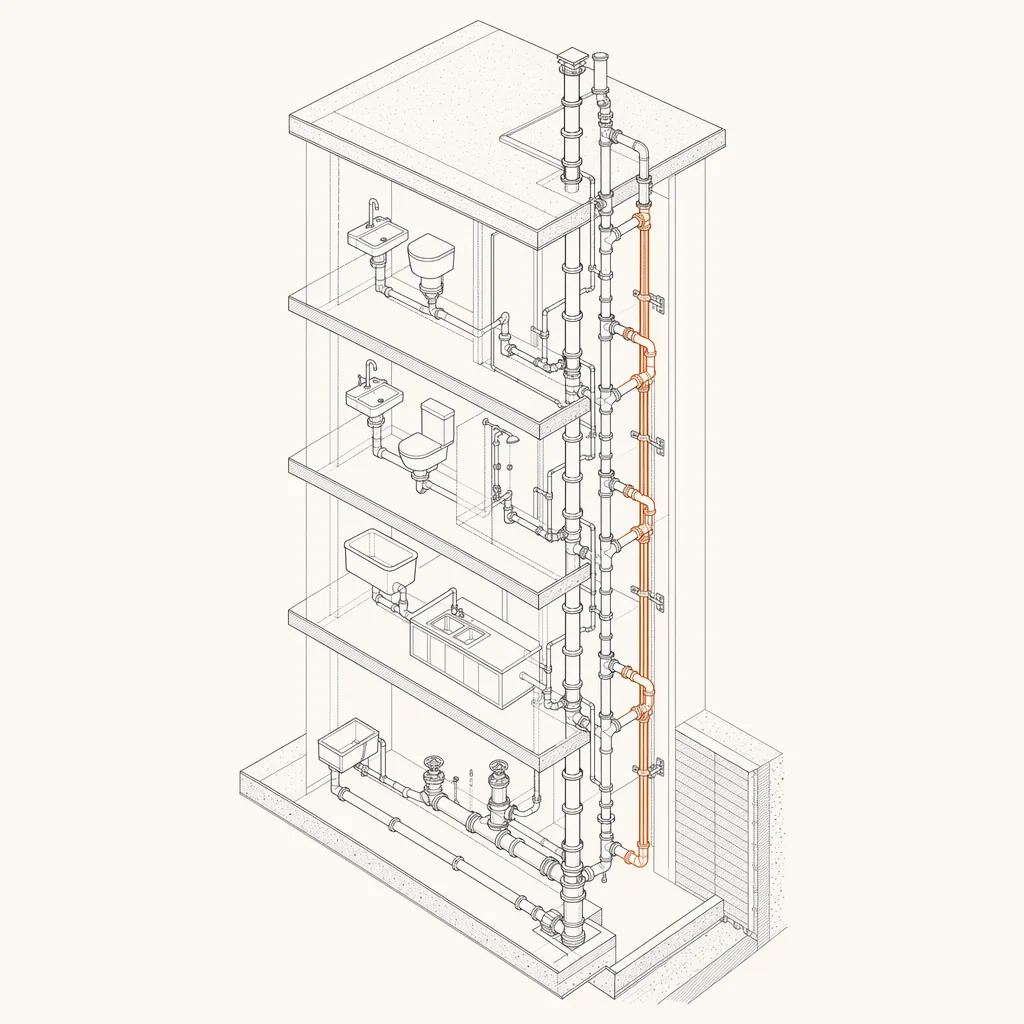
This is the easy 20%. The other 80% is on your drawings.
A fixture-count calculator prices the rough-in you can already picture. What it can’t do is read your riser diagrams and waste-and-vent isometrics: the actual pipe routing, the size transitions up the stack, the offsets around structure, the storm versus sanitary split, the medical-gas or recirc lines hiding in the spec. That’s the part of a plumbing bid that leaks money — and it’s exactly what Pilars AI takeoff does from your actual plans: it follows the routing on every sheet, counts fittings off the real geometry, and returns pipe, fittings, fixtures and carriers by system. $100 per trade, per plan.
Questions estimators actually ask
How does the calculator estimate pipe from a fixture count?
Each fixture type carries standard rough-in factors — hot and cold supply length, supply size, drain length and size, and vent length. The tool multiplies by your quantity, groups by pipe size, then adds a trunk/main percentage on the supply and a waste percentage on everything. You get supply LF by size, drain LF by size and vent LF, ready to price.
What does it calculate from my fixture counts?
Supply pipe by size (1/2″ and 3/4″), drain pipe by size (1-1/2″, 2″ and 3″), 2″ vent, supply and drain fittings, pipe hangers, angle stops, fixture supply lines, P-traps by size, wax rings, closet flanges, fixture valves, hammer arrestors, plus solvent cement and primer (PVC) or solder and flux (copper).
Does it figure WSFU and DFU loads?
Yes — it sums water supply fixture units (WSFU) and drainage fixture units (DFU) across every fixture, then suggests a water-service size: 1″ up to 30 WSFU, 1-1/4″ up to 60 WSFU, and 1-1/2″ or larger above that.
Can I download the takeoff as an Excel file?
Yes — one click exports a real .xlsx workbook with a Fixtures sheet and a Materials sheet. The Fixtures sheet carries a visible factor table and VLOOKUP formulas, so you can change quantities or factors in Excel and the quantities recalculate. There’s a blank reusable template too.
Is this as accurate as a real plan takeoff?
It’s a fast estimating tool built on standard per-fixture rough-in factors. It doesn’t read your riser diagrams, waste-and-vent isometrics or the real routing on your plans — that’s what Pilars does from your actual drawings for $100 per trade.
Let Pilars take off your whole set.
Upload your plans. Pilars reads the riser diagrams and isometrics, follows the routing, counts fittings off the real geometry, and returns the full plumbing takeoff by system. $100 per trade.