What is a construction takeoff?
It's the measured list behind every bid — the moment a stack of drawings becomes real quantities of real material. Here's exactly what it is, what's in it, and how it's done.
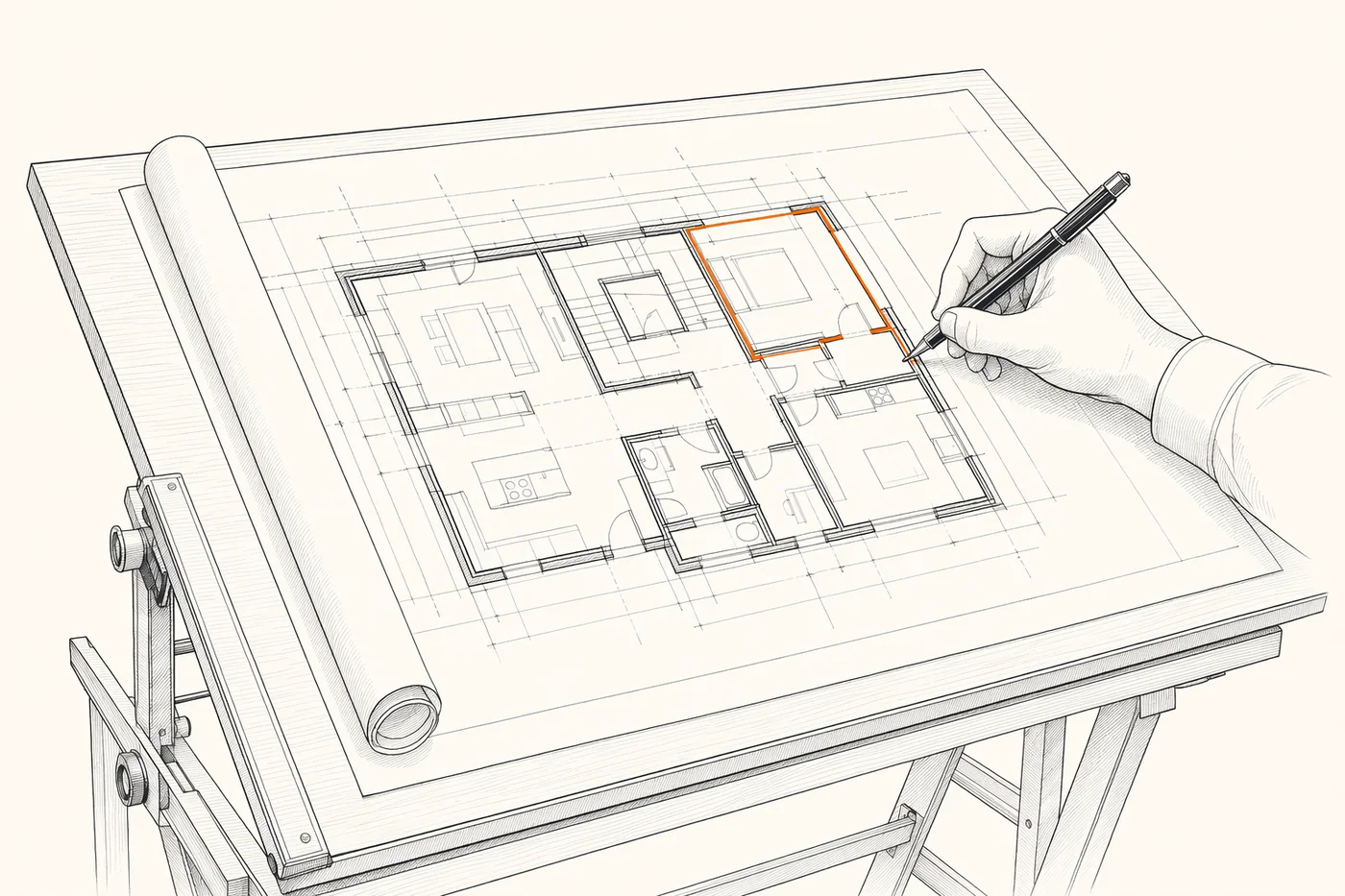
A construction takeoff is the process of reading a project's drawings and producing a measured list of every material the job requires — the counts, lengths, areas and volumes needed to build it. It answers one question: how much of everything? The takeoff is the quantity foundation that every estimate, budget and material order is built on.
If a bid is wrong, the takeoff is usually where it went wrong. Get the quantities right and the rest is arithmetic. Get them wrong and no amount of good pricing saves you. That's why estimators treat the takeoff as the most important — and most error-prone — part of preparing a bid.
What a takeoff includes
Every material on a drawing falls into one of four ways of being measured. A complete takeoff captures all four, trade by trade:
Counts
Things you tally one at a time: doors, windows, light fixtures, receptacles, plumbing fixtures, sprinkler heads, structural connections. Counted in each (EA).
Lengths
Anything linear: pipe, conduit, ductwork, baseboard, wall track, rebar, curb. Measured in linear feet (LF) by tracing along its run.
Areas
Surfaces: drywall, flooring, roofing, paint, tile, slab footprint. Measured in square feet (SF) by outlining the region.
Volumes
Bulk material: concrete, fill, excavation, insulation. Measured in cubic feet or cubic yards (CY) by area times depth.
A finished takeoff is essentially a structured table — material, unit, quantity, and usually a location reference — that someone else could read and act on. It carries no prices. That distinction matters, and it's the source of the most common confusion in estimating.
Quantity takeoff vs material takeoff
The terms quantity takeoff (QTO) and material takeoff (MTO) get used interchangeably, but they describe two different stages.
A quantity takeoff measures gross quantities straight from the drawings — 1,840 square feet of wall area, 14 cubic yards of slab, 320 linear feet of 2-inch conduit. It's faithful to the geometry and nothing more.
A material takeoff converts those gross quantities into things you can actually buy. That 1,840 SF of wall doesn't get ordered as "1,840 SF" — it becomes a sheet count of 4×8 or 4×12 drywall, plus the waste factor, rounded up to whole sheets. The MTO is what hits the purchase order. In practice the two run back to back: you measure (QTO), then you convert (MTO).
The three ways takeoffs get done
The method you use determines almost everything about speed and consistency. There are three, and the gap between them is enormous.
| Method | How it works | Residential time | Commercial time |
|---|---|---|---|
| Manual | Paper plans, a scale ruler, a calculator and a spreadsheet. Highlighter on hard copy. | 8–16 hours | 40–80 hours per trade |
| Digital / on-screen | PDF plans in takeoff software; you click and trace, the tool does the math and keeps a tally. | 4–8 hours | 20–40 hours per trade |
| AI takeoff | Upload the set; the model reads the drawings and returns measured quantities for you to review. | Minutes + review | Minutes + review |
Manual takeoff is accurate in skilled hands but slow, and every estimator measures slightly differently. On-screen takeoff removes the scale ruler and the arithmetic errors but you still trace every wall and count every fixture by hand. AI takeoff flips the work: instead of spending the day measuring, the estimator spends it reviewing quantities the software already produced — typically returning a full set in minutes rather than days. Tools like Pilars price this per trade at $100, so the time saved isn't offset by a steep license.
Who does construction takeoffs?
The estimator owns the takeoff. At a general contractor, that's an in-house estimator pricing the whole job. At a trade contractor — the drywall, electrical or concrete sub — it's a specialist who takes off only their scope. Plenty of firms also outsource to dedicated takeoff services that do nothing but measure.
Beyond estimators, project managers run takeoffs to track budgets, suppliers do them to quote materials, and owners or developers commission them for early feasibility numbers. On small residential jobs there's no separate estimator at all — the contractor measures, prices and bids the work personally, often after hours.
Where the takeoff fits: takeoff → estimate → bid
The takeoff is the first link in a three-step chain, and each step depends entirely on the one before it.
- Takeoff — measure the quantities. How much material does the job need? Output: a quantity list, no dollars.
- Estimate — price the quantities. Multiply each by material and labor unit costs, add equipment, overhead and profit. What will it cost us to build? Output: an internal cost number.
- Bid — package the estimate into an offer with terms, exclusions and a price. What will we charge to do it? Output: the document that goes to the client.
Because the chain is sequential, errors don't stay put — they cascade. A quantity you missed in the takeoff is missing from the cost in the estimate and from the price in the bid. We unpack exactly how that math compounds in takeoff vs estimate vs bid.
A worked example: one room of drywall
Theory is easy; numbers make it concrete. Take a single office room — 16 ft × 12 ft, with 9 ft ceilings — and take off the drywall for the four walls.
| Step | Calculation | Result |
|---|---|---|
| Wall perimeter | 2 × (16 + 12) | 56 LF |
| Gross wall area | 56 LF × 9 ft ceiling | 504 SF |
| Deduct one door | 3 ft × 7 ft = 21 SF | 483 SF net |
| Both sides of partition? | (perimeter walls counted single-side here) | 483 SF (QTO) |
| Convert to sheets (4×8 = 32 SF) | 483 ÷ 32 = 15.1 → +10% waste | 17 sheets (MTO) |
There's the whole idea in one table. The quantity takeoff is 483 SF — pure geometry off the plan. The material takeoff is 17 sheets — 15.1 rounded up, with a 10% waste factor for cuts and offcuts. Notice what's still missing: no labor, no screws or mud or tape (those are separate line items), and no price. That's the estimator's next job. The takeoff just told them, precisely, how much board to buy. Multiply this one room across an entire commercial floor and you can see why doing it by hand runs into the dozens of hours — and why a missed deduction or a wrong scale ripples all the way to the bid.
Why the takeoff is the highest-stakes step
It's tempting to treat the takeoff as clerical — just measuring, the easy part before the real work of pricing. The opposite is true. The takeoff is the single most leveraged number in the whole bid, because everything downstream multiplies it. Price the wrong quantity perfectly and you've still priced the wrong thing.
The stakes show up in the margins. Construction margins are thin — often in the single digits on competitive work — so a small quantity error can erase the profit on an otherwise well-run job. A wall area off by a few percent, a missed run of conduit, one elevation taken off at the wrong scale: each can be the difference between a job that pays and one that loses. That's why estimators check, double-check and increasingly lean on software to remove the manual slips that creep in over a long day of measuring.
It also explains the long, slow march from paper to digital to AI. Every shift has chased the same two goals — fewer errors and less time. Paper gave way to on-screen takeoff to kill arithmetic mistakes and the scale ruler. AI takeoff is the next step in the same direction: instead of helping a human measure faster, it does the measuring and hands the human a set of quantities to review. The work that used to fill days now fits in a coffee break, and the estimator's attention moves from finding the quantities to checking them — which is where their judgment is actually worth the most.
Questions people ask about takeoffs
What is a takeoff in construction?
A construction takeoff is the process of reading a set of drawings and producing a measured list of every material the project requires — counts, lengths, areas and volumes. It answers "how much of everything" and is the quantity foundation an estimate is built on.
What is the difference between a quantity takeoff and a material takeoff?
A quantity takeoff (QTO) measures gross quantities from the drawings — wall area, slab volume, linear feet of pipe. A material takeoff (MTO) converts those quantities into purchasable items with waste added — how many sheets, bags, sticks or boxes to actually buy.
Is a takeoff the same as an estimate?
No. A takeoff is quantities only — how much material the job needs. An estimate takes those quantities, multiplies by material and labor costs, and adds overhead and profit to produce a dollar number. The takeoff comes first and the estimate is built on top of it.
How long does a construction takeoff take?
By hand, a typical residential takeoff runs 8–16 hours and a commercial takeoff 40–80 hours per trade depending on size and drawing quality. AI takeoff software returns measured quantities in minutes, leaving the estimator to review rather than measure.
Who does construction takeoffs?
Estimators do most takeoffs — either in-house at a general or trade contractor, or at a specialist takeoff service. Project managers, suppliers and owners also produce takeoffs for budgeting and ordering. On smaller jobs the contractor often does it personally.